Open Recommendation System - Paul.ipynb for the full analysis and code.
A well-designed recommendation system helps businesses improve the shopping experience on their site, which in turn improves customer acquisition and retention. This project builds one in three parts, following a new customer's actual journey: from their first visit with no purchase history, through their first purchase, to repeat visits once ratings and purchase history exist.
- Amazon product ratings from multiple users: Kaggle: Amazon Ratings
- Home Depot product descriptions: Kaggle: Home Depot Product Search Relevance
A new customer with no purchase history is shown the most popular products on the site. This is a simple, effective way to cold-start a recommendation engine before any personal signal exists.
Once a customer has purchase history, recommendations switch to items based on that history and the ratings of other users who bought similar items. A model-based collaborative filtering approach was chosen here because it predicts products for a specific user by learning patterns across many users' preferences at once.
For a business with no user-item purchase history at all, recommendations can instead come from a search-engine-style system based on textual clustering of product descriptions: predictions are drawn from other products in the same cluster for a given set of search terms.
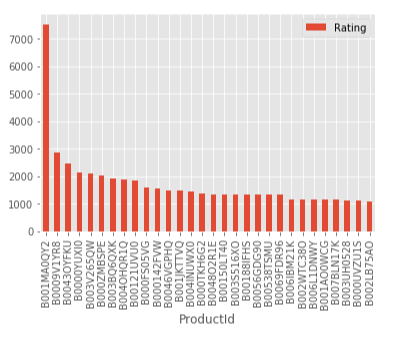
Analysis: The chart above ranks products by sales, descending. For example, product ID B001MA0QY2 has sales of over 7,000, followed by B0009V1YR8 at around 3,000, and so on.
Recommends the top 10 highly correlated products, in sequence, based on a customer's purchase history and the ratings of other customers who bought similar items.

Result: the products shown are the top 10 the recommendation system would surface to this customer, based on the purchase history of other customers on the site.
For a business with no purchase or rating history yet, recommendations can be built from textual clustering of product descriptions instead.
Product clusters (subset of data):
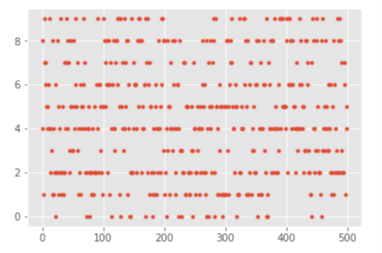
Top terms per cluster:
| Cluster 1 | Cluster 2 | Cluster 3 |
|---|---|---|
| light | painted | water |
| watt | wood | concrete |
| volt | insulation | use |
| led | ft | ft |
| power | primed | metal |
| fan | proposition | used |
| bulb | nbsp | provides |
| bulbs | residents | designed |
| lighting | california | high |
| home | fiberglass |
Once a cluster is identified from a customer's search terms, the recommendation system displays items from the matching product cluster based on product descriptions.
This approach works best when a business is setting up an e-commerce site for the first time and has no user-item purchase or rating history yet: it gives new visitors a reasonable starting recommendation. Once real purchase history accumulates, the system switches to model-based collaborative filtering for more personalized results.
No license file is currently attached to this repository; all rights reserved by default. Open an issue if you'd like to use this code and need clarification on terms.